Business Ideas / A possible next chapter
A practical experimentation school
Teach teams to write better experiment plans through a practice website, worked exercises and feedback.
Teach the decisions around the test
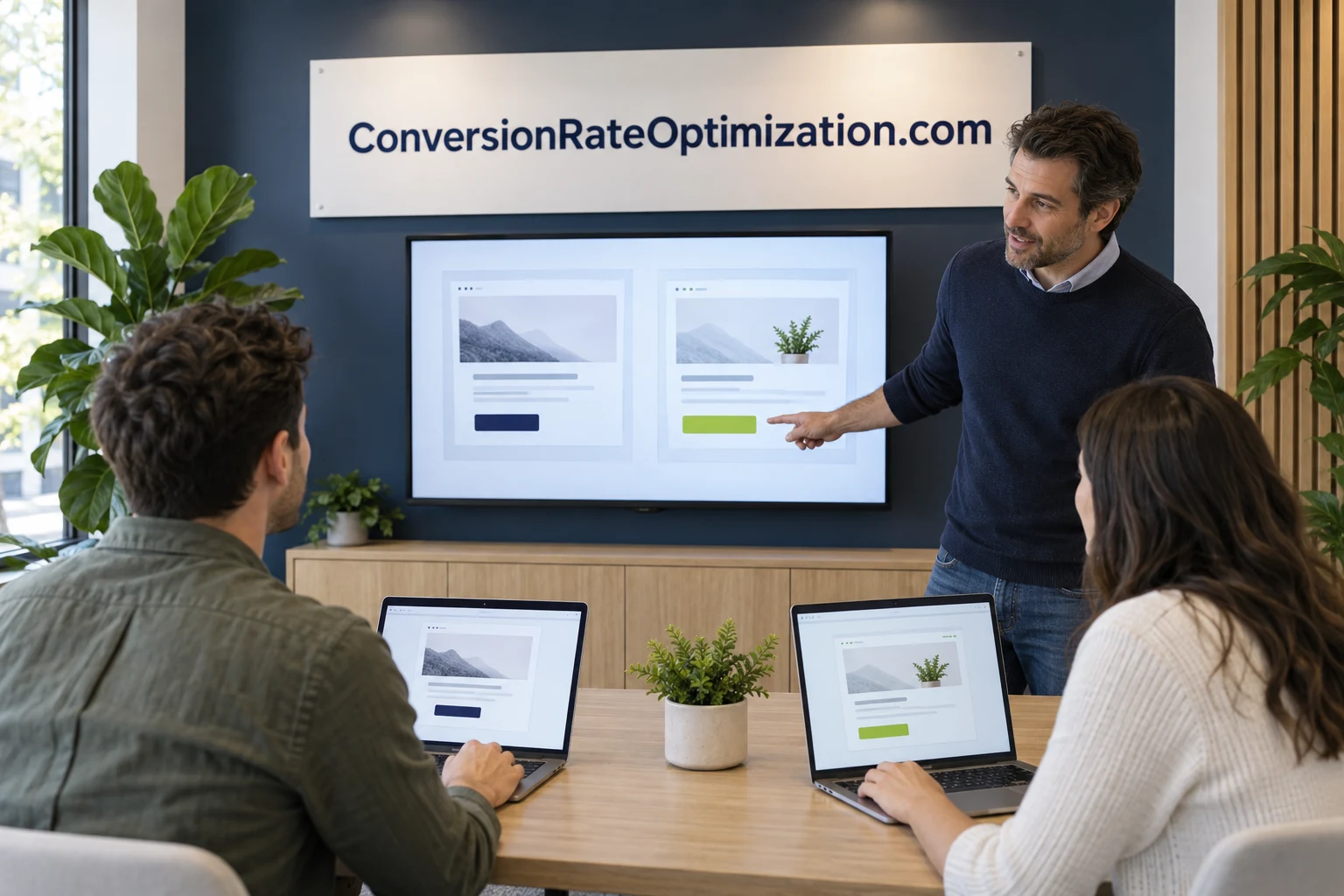
A team can learn where to click in a testing tool and still be unsure what its experiment should answer. The harder work often happens before setup: defining the audience, deciding what outcome matters and choosing a comparison that addresses the question. A practical experimentation school could teach those decisions through small exercises, feedback and a shared practice website.
ConversionRateOptimization.com could give that school a clear category address. The offer would need a narrower audience than everyone interested in growth. An initial course for ecommerce managers planning their first experiment, for example, could use familiar shopping journeys and avoid trying to teach every kind of statistical analysis at once. This is an illustrative concept for a future owner, with an education product to design and validate.
Choose one learner and one useful outcome
Imagine a manager who works with a designer and an analyst but has never written an experiment brief. The first workshop could help that manager leave with a reviewable plan: the customer problem, the proposed change, the eligible audience, the primary measure and the conditions for interpreting the result. That is a concrete outcome learners and their employers can evaluate.
The workshop should state what preparation is expected. A learner might need basic familiarity with the store's purchase journey but no prior experience using a particular testing platform. A short pre-work exercise could ask them to describe one unresolved customer question. The instructor could use those responses to distinguish learners who need measurement fundamentals from those ready to plan a comparison.
Keep the first cohort small enough that each person receives feedback. The business would need to account for the time spent reviewing plans, not just the hours of live instruction. Feedback is part of the product: it should identify the decision that needs work and explain how the learner can improve it. Generic praise or a completion badge would add little to this specific offer.
Give learners a place to practice safely
A practice storefront can make the lessons tangible. Learners might inspect a product page, find a confusing delivery message and propose a change. The site could include sample traffic and outcome data clearly labeled as synthetic. That allows everyone to work from the same evidence without requiring access to an employer's customer information or exposing a live store to classroom changes.
The first exercise could deliberately contain an ambiguous metric. One report might count checkout events while another counts people who ordered. Ask learners to explain why those numbers cannot be treated as interchangeable. The goal is to make assumptions visible before introducing more complicated testing decisions. A worked answer can show the reasoning, including which details remain unknown.
Another exercise could examine assignment. NIST's guidance on completely randomized designs describes random allocation as a design principle. A web-focused lesson could use that principle to discuss why comparing a Monday campaign with a Friday campaign may confound the page change with other differences. The lesson should distinguish general experimental reasoning from the specific behavior of a testing platform.
Make feedback follow a consistent rubric
A useful rubric might ask whether the plan names a customer problem, proposes a change connected to that problem and defines the outcome before looking at results. It could also ask whether the learner has considered who is eligible and what other changes might affect interpretation. The rubric should be visible before the exercise so students know what they are practicing.
For example, a learner might propose changing a delivery estimate because customers ask about arrival dates. The instructor could ask where those questions occur, which orders have variable delivery times and what evidence would support the proposed explanation. That feedback helps the learner improve the question instead of merely replacing the headline with a more persuasive sentence.
The school should resist presenting every exercise as a successful test. Include a result that does not support the proposed explanation and a case where the measurement was broken. Learners need practice deciding what can be concluded, what cannot and what to investigate next. A course built entirely around dramatic winners would teach a distorted picture of the work.
Sell the workshop through the exercise
A short public lesson could be the most useful introduction. Publish a practice brief with one missing decision and invite readers to identify it. Then explain the issue in a worked response. This shows the teaching style and gives a prospective learner a sample of the reasoning expected in the full workshop. It also helps the operator discover which topics generate real questions.
Potential distribution partners include ecommerce communities, analytics practitioners and agencies training new team members. The initial outreach should describe the learner and the outcome precisely. A session that helps a team produce one defensible experiment plan is easier to assess than a promise to master conversion optimization. Any partner arrangement would need its own terms and a clear description of who delivers the instruction.
A company workshop could use the same core exercise while reserving time for discussion of the team's own process. That variation would require care around confidential information. The provider could ask participants to bring a generalized problem description and use the practice site for detailed work, keeping the learning objective separate from a review of the employer's live data.
Learn from one small cohort
The first business test is a single workshop with a small team. Before it begins, ask participants to write a brief plan using their current knowledge. At the end, have them revise it and explain their changes. The comparison gives the instructor something concrete to review, although it should not be turned into a broad claim about business performance.
Follow up on which parts learners used and where they remained uncertain. That feedback can guide the next lesson, the amount of review time and the format of the materials. A larger course library can wait until the first workshop proves useful to its intended audience.
For a buyer with teaching experience and a defined professional audience, ConversionRateOptimization.com could become the address of that learning business. The next step is to specify the first workshop and the learner it serves, then discuss acquiring the domain or propose an operating partnership through the inquiry form.